

One Ocean
A Mother, a Daughter, Marine Protected Areas, and Sargassum

ONE OCEAN
A Mother, a Daughter, and Marine Protected Areas
In January of 1992, 28,000 yellow rubber duckies spilled into the North Pacific from a cargo ship near the international date line. They are still landing on distant shores — Alaska, Hawaii, Japan, the Pacific Northwest, Scotland, South Africa, and Newfoundland. The friendly floatees crossed the Northwest Passage into the Atlantic. They revealed the gyres. They showed us what the ocean already knew: there is only one.
My daughter Irene was born a year after the rubber duckies spill, in January of 1993.
The bay is choppy. Irene paddles ahead of me in her kayak, her paddle raised, salt already in her hair. I watch her the way mothers watch daughters when they think no one is looking — with a love so large it blurs into where the sky is born. A fear just beneath it: currents, the unknown. Her husband asked me and my husband to join them on President’s Day weekend to snorkel with her after she paddled out on her own last year to where the reef stops the surf. Something older squelched the fear: the memory of her a toddler here, as ever present, as crying to snorkel with me before she could swim, a way she will never be again. I am hoping to find what I remember.
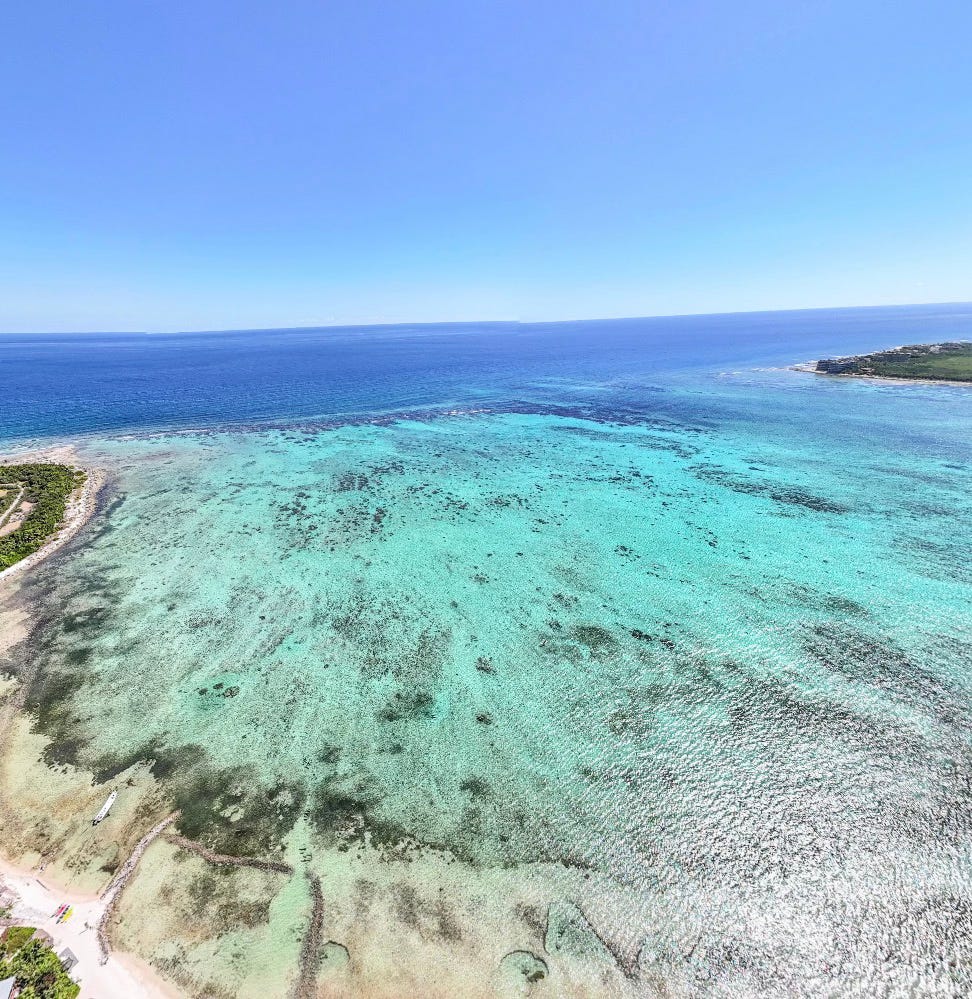
We are twenty minutes from shore on the Mayan Riviera, our kayaks loaded with snorkel gear bungeed to the stern. Ahead of us, slightly dark from the surface, lies the reason we have come: the Mesoamerican Barrier Reef, the second-largest reef system on Earth. We loop a lead line around our ankles so the kayaks will trail behind us. Nudge on fins, goggles and a snorkel. We roll into the Caribbean turquoise — that improbable, electric color that looks digitally enhanced. Once under its quiet. I see I’m in a shallow reflection of the sky above and white coral sand below. Coral grows in shallow bays.
I had not snorkeled in Mexico, on this very reef, since my children were young. The cartel violence of the 1990s kept us away for decades. This trip is different. She is grown now. We are two women in kayaks on a choppy bay, making our way toward something ancient.
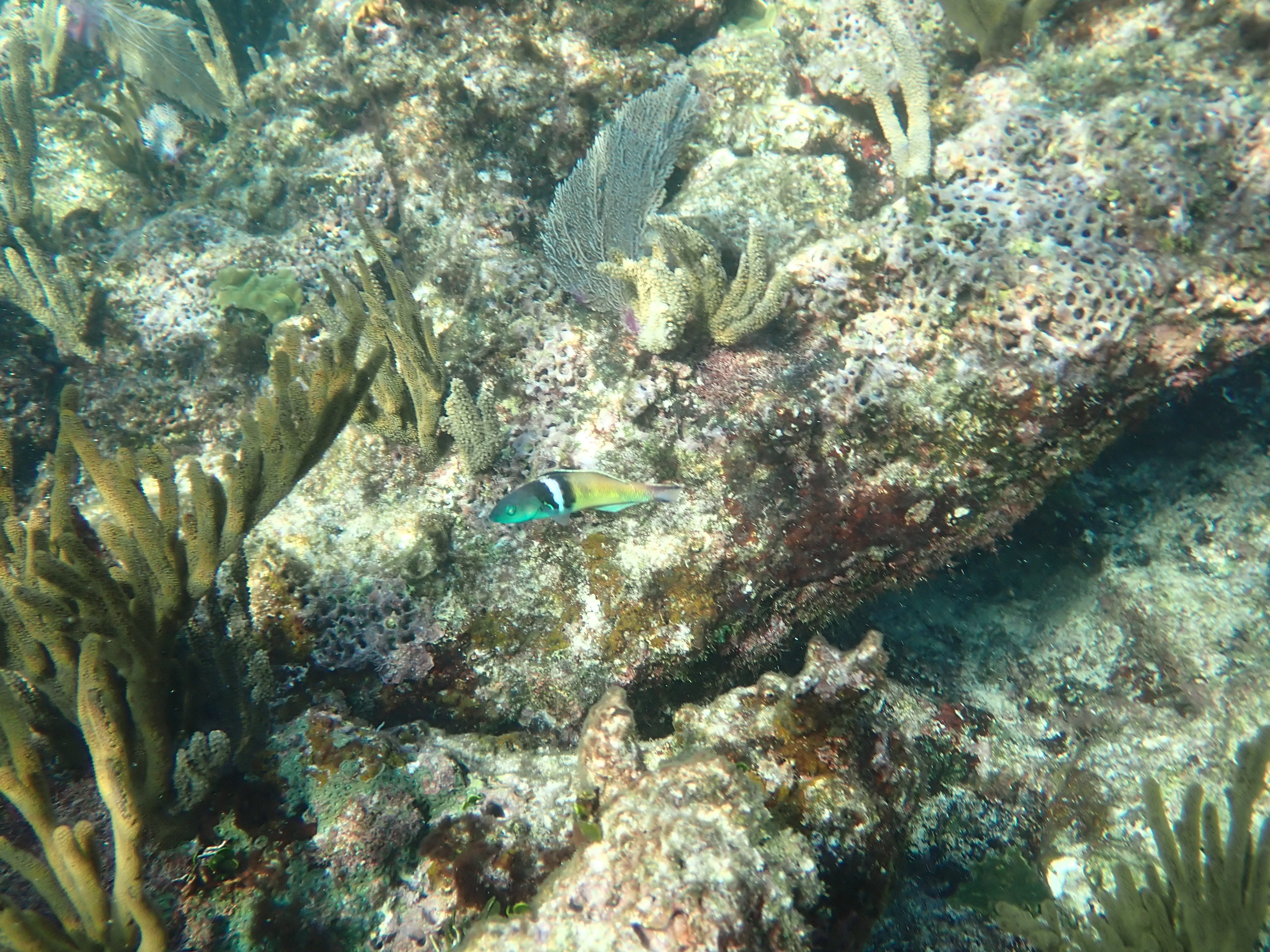
Below us, elkhorn coral spreads across the ground broken in thick piles of antler rubble— a species listed as critically endangered across most of its range. Purple fan coral with blanched edges bend in current. Brain corals rise from the sandy bottom in deep purple domed masses. Lavender finger coral reaches up and waves. Their labyrinthine surfaces, the record of centuries of patient growth with each fold honoring a living animal’s labor—the polyp. One parrotfish — blue, green, its specialized lips graze on algae to keeps the reef from being overgrown. Where are the schools of parrotfish?
We snorkel towards the center of the bay where the waves are not blocked by the reef to an explosion of coral varieties and swirling schools of fish. Healthier untarnished finger and fan coral wave, boulders boast lilac, blonde and ruddy-red. This is just like the 1980s! This reef area must have more exchange with other spores that wash in to renew the coral.
The Mesoamerican Barrier Reef System — also the Great Mayan Reef — runs for more than 1,000 kilometers, beginning at the northern tip of the Yucatán Peninsula and sweeping south along the entire Riviera Maya, past Cancún, Playa del Carmen, Tulum, and Cozumel, continuing through Belize, along the coast of Guatemala, all the way to the Bay Islands of Honduras. Four nations share its waters. More than five hundred species of fish live within it. Sixty species of coral. Four kinds of sea turtles. Manatees. Whale sharks.
Coral reefs occupy less than one percent of the ocean floor but support twenty-five percent of all marine species. The Mesoamerican Reef alone provides food security and coastal protection to millions of people across four countries, and sustains an ecotourism economy worth billions of dollars annually. Reefs protect the shoreline from more powerful waves.
Three hundred kilometers of this reef lie in Mexico. It was here, in the waters of the Yucatán coast, that I first saw the fantastic rainbows of neon fish; Tobaccofish, French Grunt, Graysby, Blue Tang, Cardinal Soldierfish, Fairy Basslet, Puddingwife Wrasse and more. The coral had not occurred to me yet. Like they are the background in a garden of colorful movement, I focused more on the flitting and hiding fish. I snorkeled here with my family for a decade before the 1990s scared us away. Coming back now, with my adult daughter beside me, I am aware of what survives and what hasn’t.
The reef I swam in the 1980s had more elkhorn, more varieties of boulder coral, and more fish. More abundance, more silence, more of the feeling that you had entered something that had been going on for millions of years and would go on for millions more after you went home. We tread barefoot on that beach. That feeling is still here — partly because of what has been protected, and partly because the expense to sustain that protection is immense.
Striving for Protection
In 1986, the Mexican government drew a line around what would become the Sian Ka’an Biosphere Reserve — 1.3 million acres of coast, forest, wetland, mangrove, lagoon, and reef. In 1987 its inscription landed on the UNESCO World Heritage List. Sian Ka’an’s name means where the sky is born in Yucatec Mayan.
The Tulum coastal waters received their own protection in 2016 with the creation of the Caribe Mexicano Biosphere Reserve. Inside its boundaries today: swimming, snorkeling, diving, birdwatching, kayaking, archaeological tours — all permitted during daylight hours. Motorized boats: banned. Artisanal fishing: tightly regulated. Lionfish — an invasive Pacific species wreaking havoc on Atlantic reefs — may be spear-hunted by divers.
A biosphere reserve is not a fortress. People live and work inside Sian Ka’an. Fishing cooperatives operate under sustainable quotas. Maya communities maintain relationships with these waters that predate the reserve by centuries. The UNESCO framework asks for protection of human life as well.
Research consistently shows that well-enforced Marine Protected Areas can increase fish biomass tenfold compared to adjacent unprotected waters. The largest fish are also the most reproductively prolific — a single large female can produce as many eggs as hundreds of smaller individuals. Protecting breeding populations has cascading benefits far beyond the MPA’s boundaries.
I point out a cluster of conch shells — five of them — in the area where we snorkeled. On our swim in, I dove down and lifted one from the elkhorn shards to show her. An encrusted shell, ancient-seeming, coated in barnacles. A crab climbed out onto its surface. I let it go. It floated down to the sandy bottom. The sand is made of broken coral — the same reef, compressed over centuries into white sand that does not burn your feet. Every shell taken removes a home. Every piece of coral taken removes some future beach.
And then Irene grabs my arm.
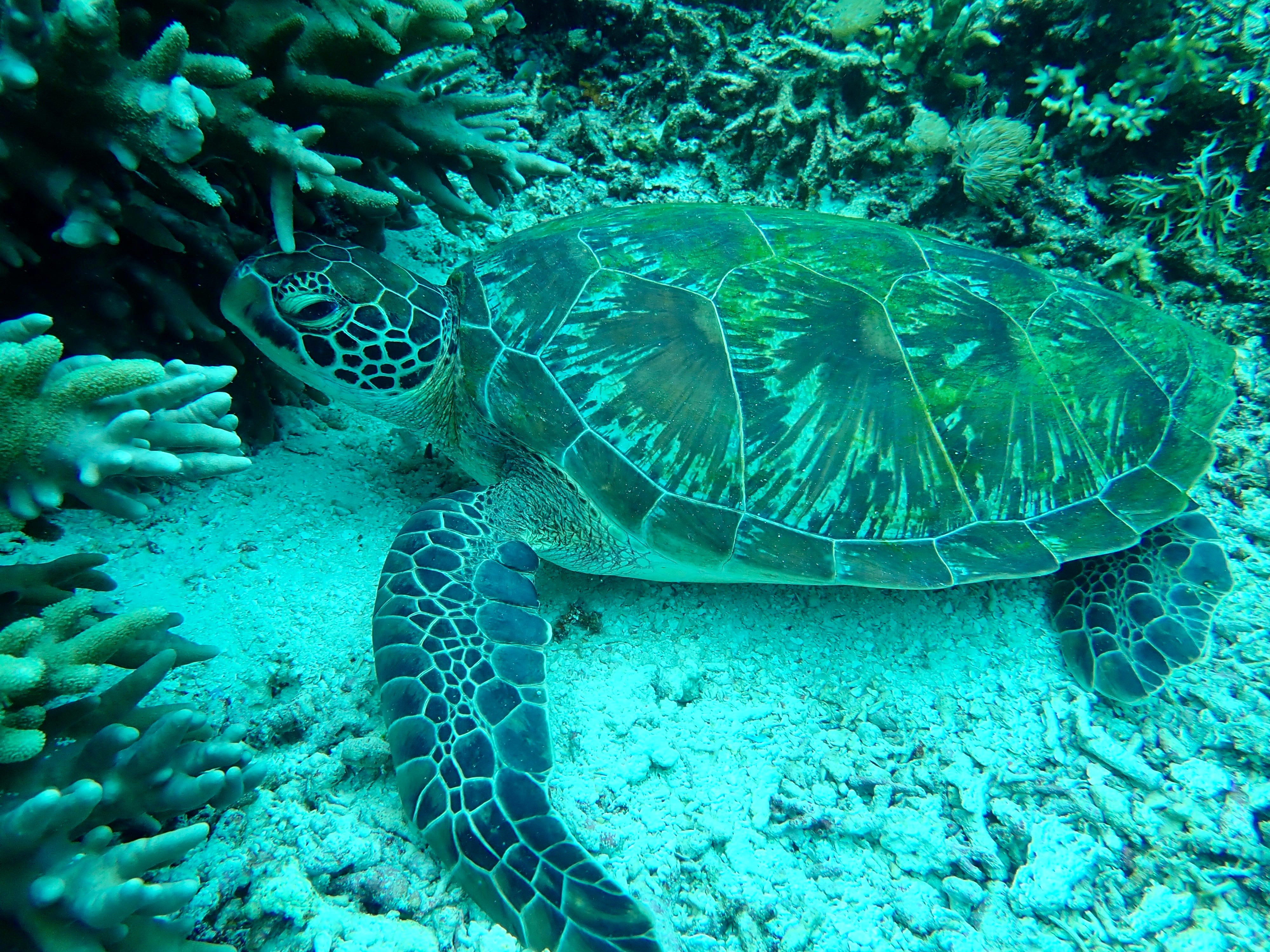
A green sea turtle — enormous, unhurried, its shell the size of a coffee table — pulls itself through the murky churned water churned by waves to nibble seagrass two feet below us. It turns one ancient eye toward us, considers us briefly, and rises to take a breath.
We surface with it. She pulls her mask up. Her expression has changed completely.
“Mom,” she says.
I know.
The High Seas and Marine Protected Areas
The MPA journey extends far beyond any one nation’s coastline.
In 2011, visionary countries and civic groups began organizing around a gap in international law. On an ocean planet, the gap was so vast it is almost incomprehensible: the high seas — that vast blue beyond any nation’s jurisdiction — had essentially no legal protection. No framework for creating Marine Protected Areas. No way to access the environmental impact of deep-sea mining. No requirement to enable developing nations to equally share the scientific and medical benefits derived from the sea.
After nearly two decades of advocacy, five years of formal negotiations, and extraordinary political pressure led in particular by the small Pacific island nation of Palau, governments reached an agreement in March of 2023: the High Seas Treaty, the first global legal framework for Marine Protected Areas in international waters.
The high seas make up approximately 61% of the global ocean. As of 2026, less than 1% of those waters are formally protected — a staggering gap, given that the ocean produces roughly half of Earth’s oxygen, absorbs nearly a third of all CO₂ emissions, and regulates the climate for the entire planet. Compounds found in marine sponges and sharks have already contributed to pharmaceuticals used to treat COVID-19. The depths remain largely unexplored.
The treaty provides legal machinery for countries to create MPAs and other management areas beyond national borders for the first time. It allows environmental impact assessments for commercial activities — including deep-sea mining — that damage the ocean. It enables developing nations to benefit equally from the genetic and pharmaceutical value of marine biodiversity, rather than having that value extracted by wealthier nations with more research infrastructure.
As of early 2026, 145 countries have signed the High Seas Treaty. More than 70, including the European Union, have formally ratified it — the legal process by which states agree to be bound by its provisions. The momentum is real. The target: 30% of the global ocean is protected by 2030.
Today, roughly 7 to 8 percent of the ocean has some form of protection. Most of it lies within national coastal waters. The high seas — that 61 percent — remain the last great ungoverned frontier on Earth. The 30x30 goal is not a ceiling. It is a floor.
Behind the treaty, largely invisible, were more than seventy civil society organizations in the High Seas Alliance, along with Indigenous communities, local fishing cooperatives, and scientists from dozens of countries who spent years building the political case for protection. Conservation at this scale is always, in the end, a human project — driven by specific people who decided, against considerable odds, that the ocean was worth fighting for.
“Destructive human activities — including extraction of resources and destructive fishing practices — should be systematically banned in these areas, and at least half should be labeled no-take zones.” — Alice Belin, Seas At Risk
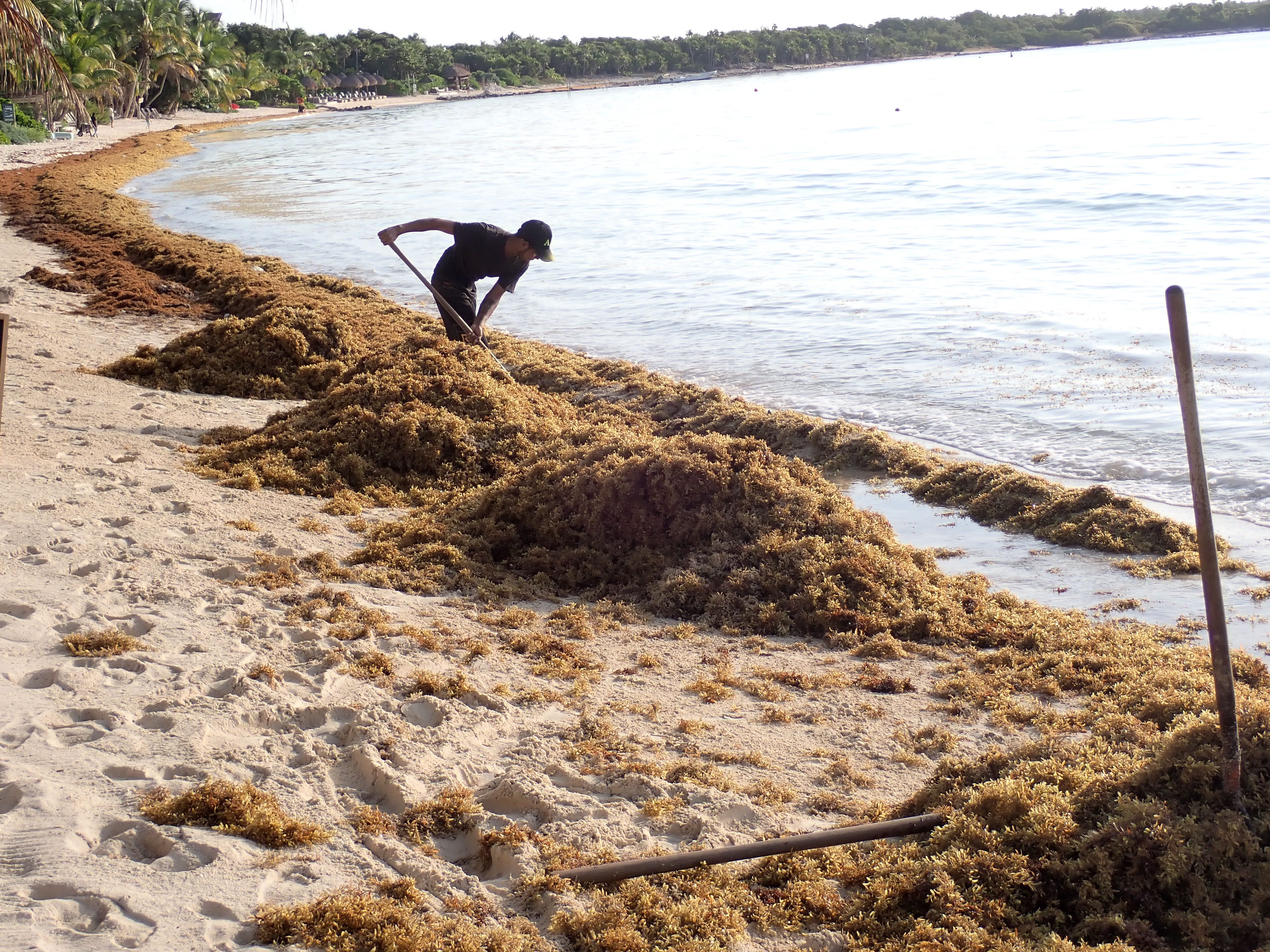
We notice it first from the kayak, on our second morning out: clumps of ochre-colored algae, the color of old tea bags, spotting the surface. By the afternoon the beaches were lined with piles of it. Islands of it floated in while we goggled under water.
Sargassum.
The word itself sounds like what it is — something between seaweed and gas. It is a genus of brown macroalgae that has existed in the Sargasso Sea, within the North Atlantic held in place by four converging currents. Since before humans walked the earth it drifted there in ecologically necessay quantities. It made a floating nursery for juvenile sea turtles and fish. Christopher Columbus noted it in his logs. Sailors feared it was a trap. It was a curiosity.
Then 2011 arrived, and the world changed.
The Great Atlantic Sargassum Belt (GASB) made its first colossal bloom in 2011, driven by an unusual atmospheric pattern that pushed sargassum southward from the Sargasso Sea into warmer, nutrient-rich tropical waters. It has returned nearly every year since, growing in both volume and duration. By May 2025, scientists at the University of South Florida recorded a record-breaking 37.5 million metric tons of sargassum in the Atlantic basin — more than double the previous record set in 2022. The belt now spans more than 8,800 kilometers: more than twice the width of the continental United States.
The cause is people. Between 1980 and 2020, the nitrogen content of sargassum samples increased by more than 50 percent, the chemical fingerprint of agricultural runoff, sewage discharge, and Amazon River nutrient-rich outflow flooding into the Atlantic. The Amazon polluted water pours into the ocean and the bloom surges. When the Amazon suffers drought — as it did severely in 2023 and 2024 — nutrients accumulate in the watershed. Rains floods all of that stored fertilizer that rushes into the sea at once. Researchers at Florida Atlantic University call it the “first flush.” What came ashore in 2025 on the Riviera Maya was part of that flush.
A 2025 study from the Max Planck Institute for Chemistry found another actor: cyanobacteria, microscopic organisms that live on the surface of sargassum. It fixes atmospheric nitrogen and converts it into a usable form for the seaweed — enabling it to grow in parts of the ocean that were once too nutrient-poor to support it. The sargassum, in other words, has developed a way to feed itself. This is not a temporary problem. GASB as a permanent feature of the Atlantic.
When sargassum reaches the coast it smothers seagrass beds when it sinks, blocking the sunlight that seagrasses need. It shades coral reefs from the sun that fuels their symbiotic algae. It creates oxygen dead zones where fish cannot breathe. As it decomposes on the beach in the tropical heat, it releases hydrogen sulfide, that smells like rotten eggs, along with ammonia, both of which irritate the lungs, trigger headaches, and can cause serious respiratory damage. Every morning and every evening crews pitchfork loads of sargassum into wheel barrels to compost elsewhere. If not a film covers the swimming pool.
In February 2026, Mexico’s Secretary of the Navy warned of a 75% increase in sargassum arrivals expected by Holy Week and in June when the World Cup visitors descend on Cancún and Playa del Carmen. In 2025 alone, Mexican naval and civilian crews collected 92,783 tons of sargassum from Quintana Roo beaches — an unprecedented figure. In 2026, the Navy has deployed sixteen surface vessels, four specialized amphibious sargassum collectors, and 9,500 meters of floating barrier to intercept the algae before it reaches shore. The colossal mass currently moving westward toward Cancún, Playa del Carmen, Tulum, and Cozumel weighs an estimated 280,097 tons.
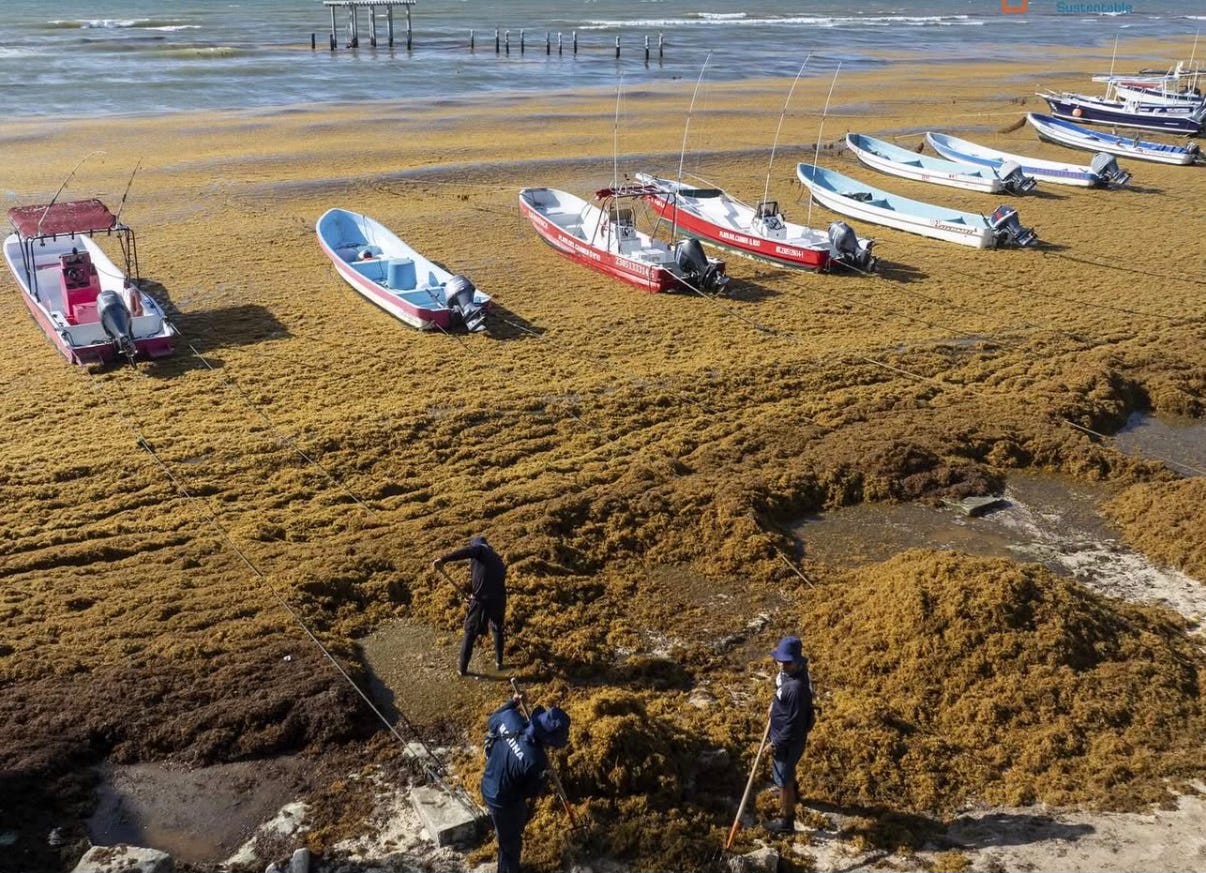
On March 16th, 2026 tons of sargassum continued to arrive on Playa del Carmen beaches. The magnitude of the problem requires larger action.
Dr. Lorenzo Álvarez-Filip, of Mexico’s National Commission of Natural Protected Areas, has tracked a related catastrophe: coral disease. Inadequate sewage treatment, introduces the bacterium Serratia marcescens into reef waters. This organism, which normally lives in human intestines, attacks elkhorn coral, causing white lesions leaving the animal’s limestone skeleton exposed to wave action and further infection. White pox disease has wiped out 88 percent of elkhorn coral in the Florida Keys. The Quintana Roo coast may be next, unless the water quality improves.
The 2028 White Syndrome — the deadliest coral disease yet recorded — attacked coral already weakened by warming, tourism pressure, and compromised water. The diseases are not random. They are the biological result of choices made by people.
On our last afternoon, Irene and I hiked to the next undeveloped bay. We snorkeled in a cenote lined with red mangroves, their prop roots tangling into the water like the fingers of enormous hands. Woodpeckers percuss the palm trunks above. Eagles soared. “This thrill of entering an unknown cenote, the nursery in the mangroves, and unkempt beaches. This is what it was like in the 80s,” I say.
There is something that happens when you travel with an adult child and the world opens for them in front of you. You see it happening like they are that toddler. The thing that was abstract becoming real. Protection is a policy until you understand that without it, the turtle would be gone.
She has known her whole life that the ocean is in trouble. She has signed the petitions, watched the documentaries, recycled the plastic. But the ocean in trouble. She is now chasing coral reefs before they are gone.
We have snorkeled together in the Great Lakes, the Great Barrier Reef, Puerto Rico, the Mediterranean, Hawaii, and now, again in the Mayan Riviera. It feels like returning home to our reef — one we need to watch over.
Governor Mara Lezama of Quintana Roo announced in January of 2026 the installation of State Councils of Peace and Civic Justice for the Caribbean coastline — a formal framework for community dialogue, social justice, and human rights that will benefit over two million people. Peace, she said, can be sown from every neighborhood. It is the kind of governance that makes conservation possible: communities that trust their institutions are communities that will defend their reefs.
That evening, we sit with our husbands on the terrace of our small hotel as the sun goes down behind the jungle. The Caribbean goes gold and then rose and then a deep, improbable violet. Pterodactyl-dark Frigate birds circle above the water on thermals rising from the warm sea. Somewhere below the surface, in the darkness, the reef is going on without us: coral polyps extending their tentacles to feed on the night plankton, parrotfish sleeping in mucous cocoons for protection, the turtle we saw this morning moving through the dark water to wherever turtles go.
The sargassum is not going away. The warming that drives it is not reversing. The agricultural runoff pouring into the Amazon and the Atlantic will not stop overnight. What can be done is manage, mitigate, monitor, and in some cases spin gold from it: in Grenada, entrepreneurs are converting sargassum to biogas and fertilizer. The Inter-American Development Bank is funding projects that explore using it in construction, making shoes, and cosmetics.
What can definitely be done — what is being done, imperfectly and expensively but with real effect — is protection. The reef we snorkeled is healthier than the reef would be without its MPA. The turtle we saw is alive in part because the fishing pressure around it has been reduced. The elkhorn coral growing in these waters is growing because the water quality here, while threatened, is better than in the north.
Protection is not a solution to climate change, but it gives nature a fighting chance. A reef with adequate fish populations and clean water can recover from a bleaching event. The MPA buys time.
One Ocean
The rubber duckies are still out there. Oceanographers track them. Children find them on beaches in Scotland and send photographs to researchers who plot their trajectories and update their models of how the ocean moves. The duckies have crossed the Northwest Passage, drifted down the Atlantic, washed up within a few miles of the Titanic’s resting place. They have been at sea for thirty-three years. They show no signs of stopping.
The ocean that carries them is one ocean. The current that brought sargassum to the beach below our hotel this morning is the same current that carries melt from Greenland past Newfoundland and down into the Caribbean. The water that evaporated to form the clouds above us fell as rain in the Amazon and ran off into the Atlantic and arrived here as nutrient-loaded runoff that feeds the bloom. The coral that built the Yucatán Peninsula under our feet grew from the same sunlit sea that now threatens to swamp it.
My daughter has swum in this one ocean for decades. She knows its gray green color in the Great Lakes, the deep blue of the Mediterranean, the impossible turquoise of this reef. She knows what it smells like at low tide and what it sounds like at midnight and what it feels like to roll off the back of a kayak into trusting the water will hold her. She knows, now — in her body and not just her mind — what it looks like when it is protected.
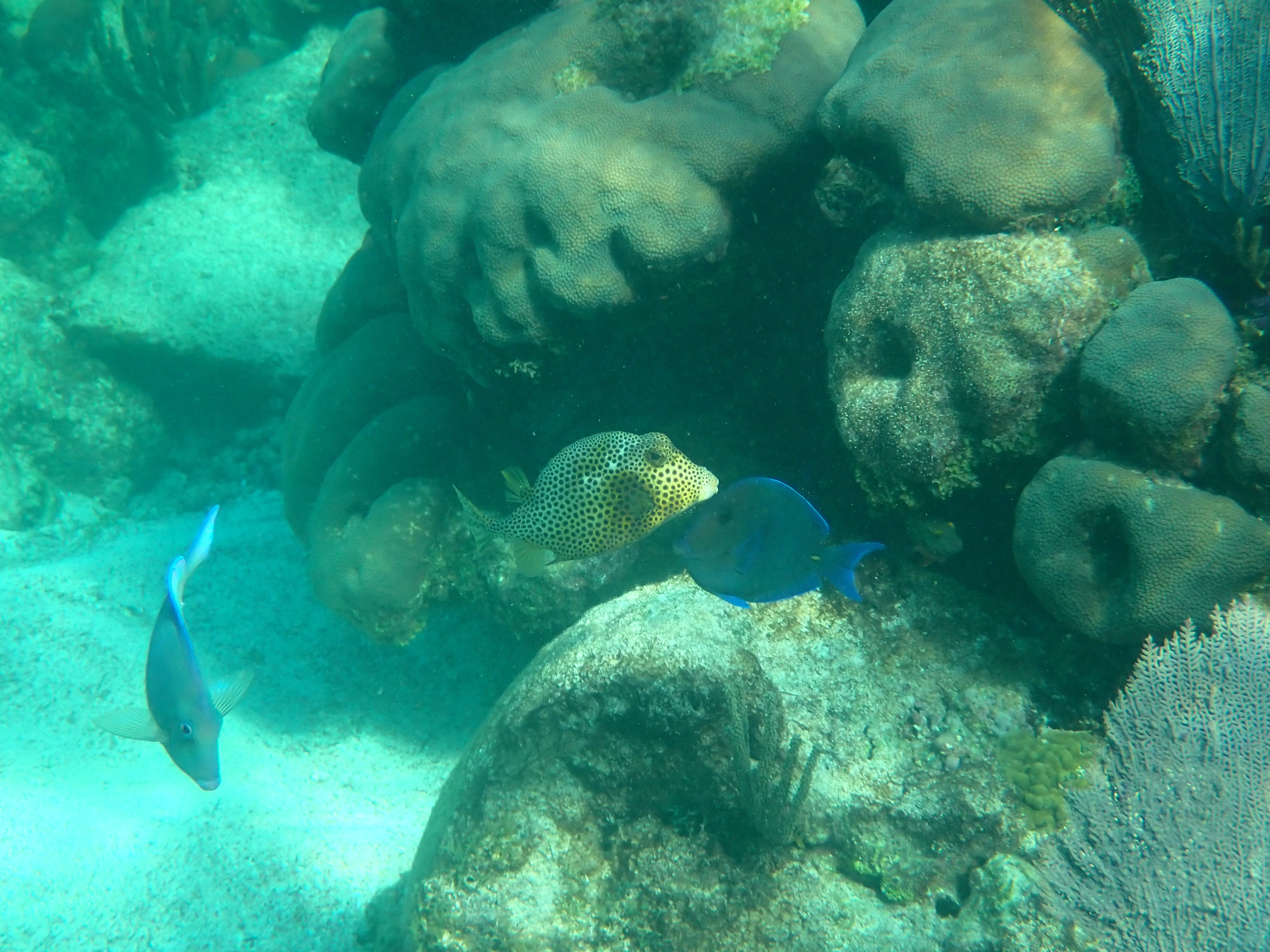
On our last evening, she is quiet for a long time. I thank her for showing me this uplifting place and, “I want to come back here with your nephew, my grandson someday.”
That is everything. That is the whole argument for the MPA, for the High Seas Treaty, for the 30x30 target, for the naval vessels intercepting sargassum offshore and the scientists mapping the bloom from satellites and the lawyers negotiating text in Geneva and the Maya fishermen reporting the conch counts to the cooperative and the community councils of Quintana Roo sowing peace from every neighborhood.
All of it is so that in forty more years, there will still be something here worth showing.
Further Reading
Support the fight against sargassum on the Mexican Riviera: hmbsargassumproject.com
Amigos de Sian Ka’an — protecting the Sian Ka’an Biosphere Reserve since 1986: amigosdesiankaan.org
Healthy Reefs for Healthy People — annual report card on the Mesoamerican Reef: healthyreefs.org
High Seas Alliance — the coalition that drove the High Seas Treaty: highseasalliance.org
University of South Florida Sargassum Watch System — real-time tracking of the Great Atlantic Sargassum Belt: optics.marine.usf.edu/projects/saws.html
The Mesoamerican Barrier Reef is listed as critically endangered. The High Seas Treaty, as of March 2026, has been signed by 145 nations and ratified by more than 70. The 30x30 target — protecting thirty percent of the global ocean by 2030 — remains achievable. The reef is trying.
Margot McMahon
UNESCO Ocean Literacy Certified
www.margotmcmahon.com